Columbus Park
Neighborhood Association Meeting- the third Wednesday of the month at 6:30 p.m., 580 Campbell, the Don Bosco Senior Center.
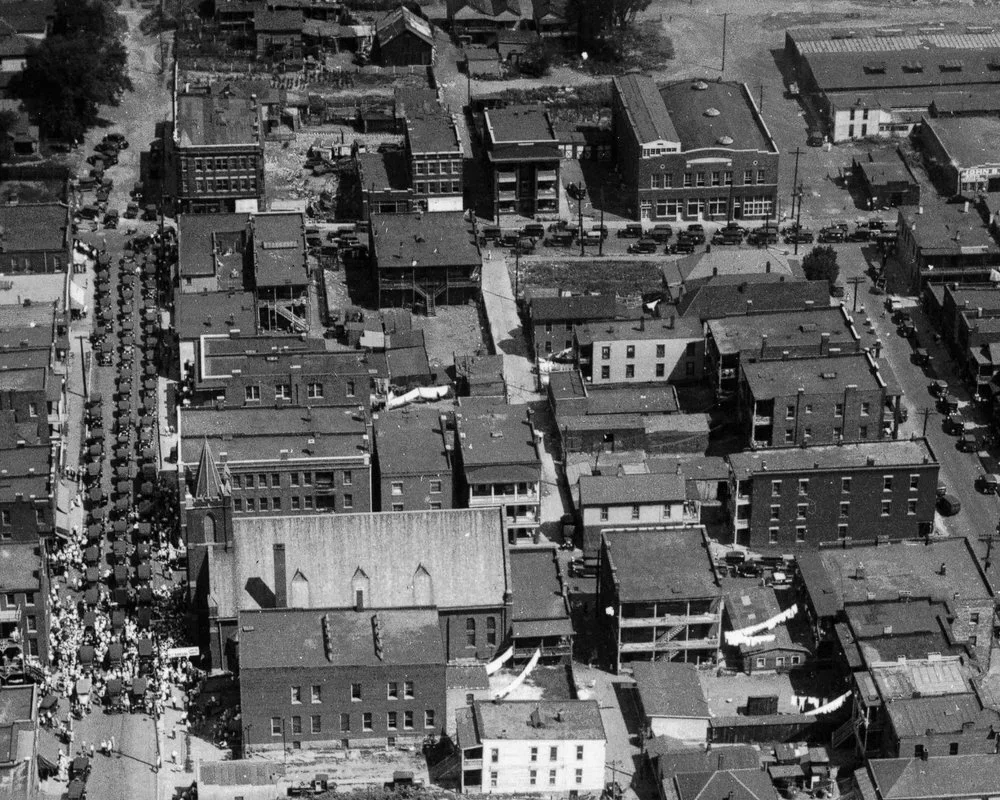
Columbus Park sits on some of the oldest ground in Kansas City, with part of the neighborhood included in the original platting for the Town of Kansas in 1853. Its early history is closely tied to the Chouteau family. Francois Chouteau is remembered as the first permanent resident of non-Native American origin, living in the area by 1826, and his brother Cyprian later built a home at 412 Charlotte after the Civil War. The neighborhood also holds some of the city’s earliest surviving architecture, including the home at 513–515 Holmes Street (1857), and it was the setting for major early landmarks like the Campbell mansion at 3rd and Campbell (1860). Dr. Benoit Troost settled nearby in the 1840s, connecting the area to Kansas City’s cultural history through his friendship with artist George Caleb Bingham, whose portraits of Troost and his wife are in the Nelson-Atkins collection.
Over time, the area’s identity shifted and expanded. It appeared in different eras as Belvedere Hollow, Billy Goat Hill, the North End, and later Little Italy, reflecting a neighborhood shaped by steady change and growth. Holy Rosary Church, established in 1891 by the Scalabrini Community, became a central anchor as waves of immigrants and new residents arrived, including Russian Jews, Poles, Germans, and Italians (especially Sicilians), along with Black residents served by Garrison-era institutions prior to desegregation, and later Mexicans, Cubans, and Southeast Asians. Once a thriving corner-store neighborhood and home to some of the city’s earliest organized sports grounds, Columbus Park was hit hard after World War II by urban renewal, highways, suburbanization, and disinvestment, compounded by a damaged reputation tied to Mafia-era criminal activity. Even so, the neighborhood endured through deep family roots, pride of place, and residents whose dedication, often spanning three to five generations, kept Columbus Park alive and evolving.